
Want a screen FREE childhood? Music is the answer


Hello and welcome.
As we approach the end of 2026, I want to use this post to address an issue I feel strongly about: society's increasing reliance on screens and technology, from education to library time. However, there is a better approach—a creative, engaging way to step away from screens and immerse in meaningful time with your child from birth to age five.
Recent research highlights the importance of these early years, which are critical for developing a child's ability to perceive and interact with the physical world.
Let's consider what parents truly want: childcare that provides a childhood free from screens—carefree, in nature, with plenty of sunlight and fresh air.
Sounds ideal, right? I believe carers play a crucial role in making this vision a reality, and in the early years, from birth to age five, music is the key. Let's explore what that might look like and consider simple music activity ideas for stay-at-home parents, nannies, or childminders working in a home setting.
This post provides practical ways to shift the balance and hopefully renew your confidence in using physical musical activities to fill your day with joyful, melodic engagement for both you and the children in your care.
When the day feels long, and stress levels are up, screens can seem like the easy option. But we think differently about music as a critical experience in the lives of children, especially the ones not yet in formal schooling. I call these first 5 years on the planet as "the golden years".
Every week I get to help exceptional childminders and nannies, as well as families who value music as a core subject and a cross-curricular enabler, to understand and deliver the most enriching developmental music activities from birth.
It's a rewarding experience for all.
"Often a single experience will open the young soul to music for a whole lifetime. "- Zoltán Kodály, composer and music educator
What the music guidance now says
You don't have to take my word for it. In March 2026 the UK government published its first screen time guidance for parents of under-5s.
It was developed with parents and an expert panel led by the Children's Commissioner, Dame Rachel de Souza, and Professor Russell Viner, a pediatrician. Here's a comparisson grid to check what's changed:

Here is what stood out to me in the early years research of the reality of screen use in children from birth to age 5 which has affected this guidance:
98% of two-year-olds watch screens daily, according to the figure the government quotes.
90% of children's development happens before the age of five. Large amounts of unmanaged screen use can crowd out sleep, physical play, creative activity and talking with the adults who care for them.
Research by the charity Kindred Squared found that 28% of children starting reception couldn't use a book properly. Some tried to swipe or tap the pages like a tablet.
It advises slow-paced content over fast-paced, social-media-style videos. It also says to avoid AI toys, tools and chatbots for young children for now.
It tells us to lead by example. Children copy what we do, and long stretches on our own phones make it harder to notice what they are doing and feeling.
The time limits don't apply in the same way to assistive technology that supports children with SEND.
The guidance doesn't ask for perfection. It asks for small swaps, and music is one of the easiest swaps there is. The government's own suggestions even include background music at mealtimes in place of screens.
Where I started
Almost 18 years ago, when I had my first child, I was lucky enough to have a full-time, live-in nanny 5 months after Samuel was born. My first request was simple: no screens, apart from half an hour of TV in the morning and half an hour in the afternoon, an hour at the very most. We kept that rule as my second and third children arrived.
I was immersed in education, practicins as a music teacher, teaching piano, recorder and ukelele after school, and our house was full of instruments. My children always had access to a very dynamic home.
I know not everyone has that. Looking at today's guidance, I'd tighten the rule for the very youngest children. But in our world, you don't need a house full of instruments to do this. You need intention, a few well-chosen resources and a routine.
Our duty as parents and carers
Let's be honest with ourselves. It isn't up to the government or outside organisations to raise our children. There is a cultural trend and a huge wave of technology around us. We can shield our children from that pressure for as long as we possibly can, and we can fill the space with something better.
We have the duty and responsibility to raise well-rounded children, and to give them an identity through music activities before they reach mainstream school.
There they will meet the stresses of other children, new adults and changes in routine. We can't let them face that cold. We need to build this into our care.
"What a child becomes depends entirely on how he is educated." -Shinichi Suzuki, founder of the Suzuki Method
Why the first 18 months matter so much
The first 18 months are a time of extraordinarily rapid growth. Babies are building connections in the brain and linking them with the body, the senses, their emotions and their sense of who they are.
Music engages all of these at once. A lullaby carries language, rhythm, touch, eye contact and emotion in a single moment. Rocking, bouncing and swaying support the body's sense of balance and movement.
Singing together builds the human bond, which is the foundation for later social and emotional skills. The approach we use in our sessions draws on Edwin Gordon's Music Learning Theory.
It says children need to be immersed in rich musical sound before formal learning, just as they are immersed in language before they speak.
"It is through movement that the child arrives at understanding music. It is not only by playing and singing for the child that this happens; he must understand it by his own movements. "- Maria Montessori, The Montessori Approach to Music, p. 33

Three tips you can start using today
Tip 1: Make your transitions meaningful, and build in 15 minutes of music twice a day
Think about the key moments in your day: arrival, getting dressed, tidying up, washing hands, nap, story time, home time. Give each one a musical signal, such as a song, a chant or a short piece of music. Children feel safe when they know what comes next, and that helps them cope with change later.
Then add 15 minutes of "Music in a Moment" in the morning and another 15 minutes later in the day. That's half an hour of rich engagement, and you can follow the children's interests.
Make it as cross-curricular as you can. Pull out a basket of resources (scarves, shakers, a ukulele, an ocarina, a drum) and let the children explore. Nothing stops you exploring an instrument with your child. For example consider these cross-curricular examples:
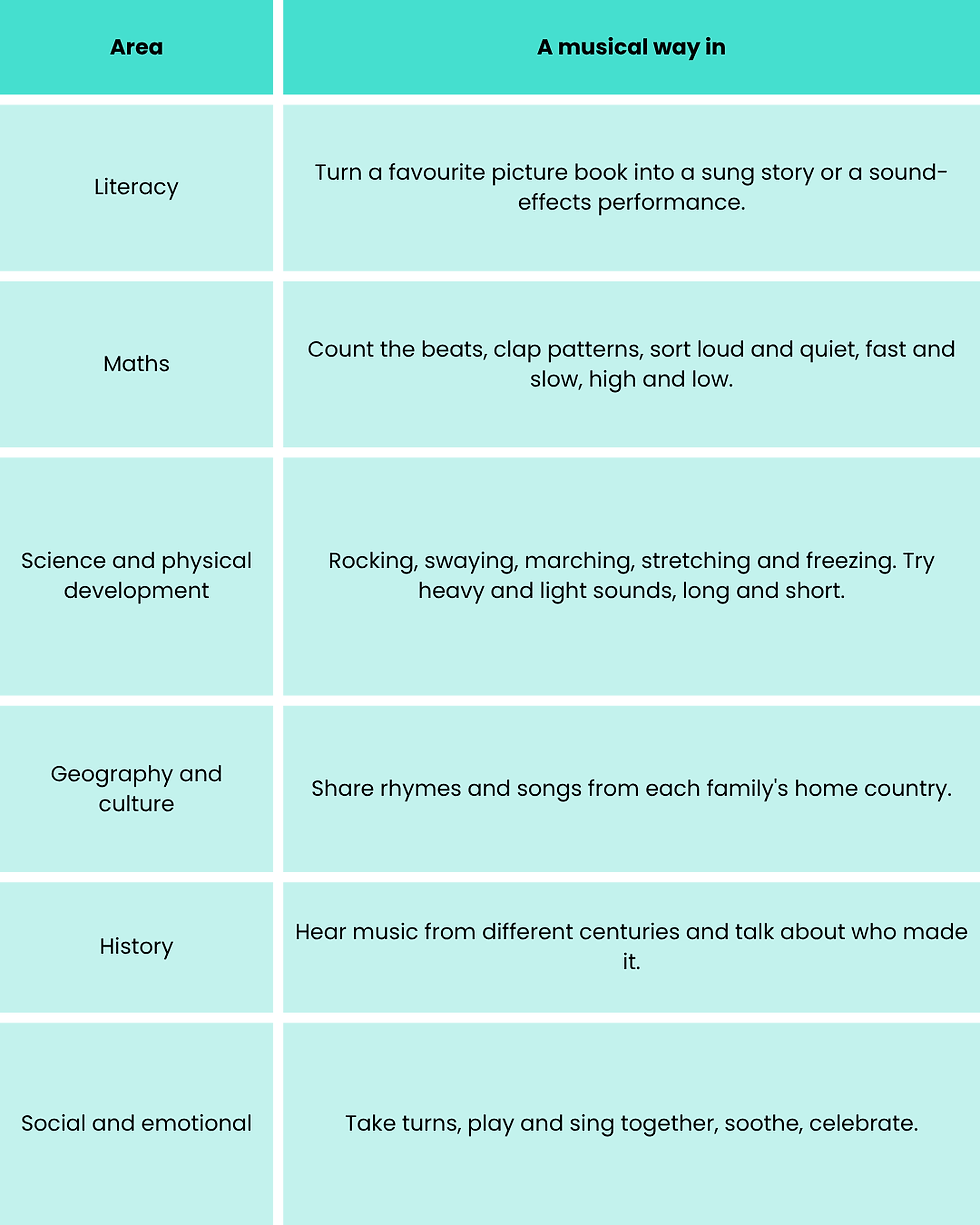
Tip 2: Choose quality music suitable for little ears
Start with well-crafted pieces that have pure, clear instrumental sounds, and mix them with nursery rhymes, including rhymes from both parents' countries if their families come from more than one place. Choose music with some history behind it, the kind children will hear later at events, in museums and in public spaces.
My 10 recommended pieces and composers to use from birth to age 5

Recommended Nursery Music rhymes to mix in
Sing these in whichever key suits the children's voices, such as middle C, F or G. Change the key from one day to the next so they hear different tonalities.

Ask the families in your setting for their own songs. A child hearing the music of their own home, valued in your setting, learns that they belong.
Tip 3: Create three playlists to speed up the process
We in our family use Spotify but you can use any music app out there:
Transition times playlist, - Arrival, getting dressed, coming in, washing hands, nap, reading time, bedtime.
Stories, themes and film playlist,- Book and theatre pieces or film music you love, organised by theme: seasons, weather, big stories.
Their favourite songs playlist,- The songs your child loves to hear over and over again. Repetition is how little ones learn, so enjoy it. Make sure you create one per child as they may have different tastes and these will also change with age.
Childminders, Nannies and Parents, Let's take control
We took years to build a habit of reaching for screens, so it may take us a while to undo it. But we can do it, and the early years are where it counts most, before children reach primary school and are exposed to many more influences.
I'm here to help, and so is our community of carers and educators who value high-quality early years care. That's why I'm sharing our November 2026 "Music in a Moment" Activity Calendar. It is clearly structured, and each activity is marked indoor or outdoor so you can plan around the weather.

Your free November 2026 -15 min Music in a Moment activities suggestion planner
We normally charge £9.99 for a custom music activities planner, but it's yours at no cost when you click below. Just use USE CODE "NOVEMBER26" on checkout:
You don’t have to be perfect, you don’t even have to be a music teacher or play an instrument. Start where you are. After you read this blog, if you have questions, suggestions or comments, I'd love to hear them. Please share any great sessions with me via our socials on Instagram, Facebook or LinkedIN.
I hope that you make the most of the FREE calendar during your month of November, and enjoy the 15 minutes a day music boost with the child or children in your care.
Please reach out for any support you need from my network. We are delivering workshops every two weeks so please sign up and have an offer for you inf you wish to join our ongoing "Music in the Moment : Foundations".
You’ll love it!
Thank you for reading.
Maria
Director, Maria Moon Music CIC


Very inspiring and useful